Showing posts with label TERFs. Show all posts

Thursday, January 04, 2024

Speaking of False Premises

Back in the comments over here, we have quite a doozy of a comment that warrants a more detailed response, because there are underlying assumptions and beliefs that are encompassed that range from misguided to flat out wrong.  


Wow - where to begin with this?  Let’s start with long standing campaigns to erase transgender people from society.  Those range from accusing the transgender community at large of being “groomers” (coded slang for pedophiles), to denying them access to public washroom facilities, and a plethora of laws being tabled which are clearly designed to all but ban transgender people from accessing needed health care, or even basics like the right to exist peacefully in their communities (and it’s in the order of hundreds of these laws in the US, and other countries like the UK and Canada have similar campaigns but the scope of them isn’t as ridiculously huge for a number of reasons).

Discrimination is an ongoing problem for the transgender community, resulting in everything from being excluded socially to under-employment.  Laws like Canada’s C-16 are helpful in setting the tone and providing guidance to the courts, but they are a long ways from addressing the underlying societal prejudices.  It’s stunning how much discrimination and hatred is claimed in the name of people’s “deeply held religious beliefs” (something I argue is used as a shield for holding “views” that are otherwise reprehensible, especially in the context of what their religion preaches on other matters).  

At its core, the most fundamental of rights - that of being able to move through society without facing a constant barrage of hostility, discrimination, and hatred - is routinely denied to transgender people (and transgender women in particular).  There are clearly those who would round all transgender women up and lock them away in camps (and yes, I’ve seen musings on the part of US anti-trans activists along those lines).


The accusation that “transgender people are lying about their sex” is one of the oldest canards in the anti-transgender arsenal, and it’s based on a deeply misguided understanding of what being transgender means.  In an ultimate irony, it’s rooted in a deeply misogynistic belief about women in general.  The idea of trans women as “deceivers” has long been a staple of attempted defences in court cases ranging from rape to murder.  If it sounds familiar, it’s because it’s based on the same false premise as the argument that “because a woman was dressed a particular way, she was “leading the man on” - it’s a variation of the Madonna/Whore paradox. One might call the transgender equivalent of this the Woman/Drag Queen paradox.   Anti-transgender misogyny is still misogyny at its core, and it takes on many of the same tropes as a result. 

Which leads us into what our commenter calls “the weeds” of the sex versus gender issue. Except it’s not “the weeds” at all, because it’s a point that is deeply central to the experience of being transgender.  Going back to Harry Benjamin’s works on the matter, we find a fairly consistent pattern of transgender people saying (in essence) that their inner experience of their bodies and their experiences socially are deeply discordant with their overall person.  They see themselves one way, but they experience a social environment based on their body which they often cannot relate to at all. 

Allow me a bit of a sidebar discussion here of the relationship between the body and social roles: 

One feature of transgender narratives that is important to understand is the understanding that the body and social roles in our society are deeply intertwined.  That is to say that being a woman in society has both physiological as well as social components.  Likewise, so does “being a man”.  

Some of those components are biologically essential - the ability to bear children is often cited as an example, yet at the same time we also know that just because a person can bear children doesn’t necessarily mean that they are psychologically inclined towards the kind of nurturing and caregiving that is intrinsic to being a mother (it doesn’t mean that they are necessarily abusive, just that they have no interest in being a parent - tragically this is sometimes only discovered after the birth of a child).  

However, there is an entire social sphere that exists associated with the general idea of being a “woman”, and that covers a wide range of factors, ranging from social connections to how one is interacted with in public settings.  The concepts of manhood or womanhood have multiple facets, and it is important to recognize that a lot of it is social, not intrinsically biological in nature. Transgender people are acutely aware of this kind of distinction, and they take many difficult steps in life in order to fit in to the social context that feels more natural to them. 

Which brings me to the issue around “trans women are women”.  The class “woman” in our society has both physical and social / emotional components.  At their core, the transgender woman is a feminine person who happens to start off with a male physical body.  So, the statement our commenter makes about “transgender women are feminine” is in some respects correct.  But - society as a whole has this binary conceptualization that we have “men” and “women”, and frankly a “feminine man” is in for a very rough life at the hands of the other “men” in society.  From a social perspective in particular, the statement “trans women are women” is quite true.  

That brings me to matters of sex denominators on public identification documents.  There are a whole host of reasons why it’s important for transgender people to be able to change those documents.  Putting a transgender woman into the male lockup after an arrest is basically setting the person up for a violent assault or worse (yeah - we know damn well that assault and sexual assault is a thing in men’s prisons - we’ll come back to that in a bit).  Similarly, sending a transgender man into the ladies’ changing room isn’t exactly setting things up for a successful outcome either.  Here, the social aspects of “man” and “woman” often prevail over the physical aspects of their bodies.  

Although I don’t agree entirely with Ann Fausto-Sterling, her book “Sexing the Body” is a fairly decent exploration of the complex interactions between the physical and social aspects involved here.  Similarly, from a more transgender feminist perspective, Julia Seranno’s “Whipping Girl” explores more of the complex subject.

What about “women-only” public spaces (locker rooms, washrooms, etc)?  On this subject, I see it as a matter of individual judgment and behaviour.  Transgender women have been using “the ladies’ room” for a lot longer than the current anti-trans panic has been around, and for the most part there simply hasn’t been a problem.  

Sure, many salacious headlines are written when a transgender person _DOES_ step out of bounds and engages in anything from voyeurism to sexual assault in these contexts, but let’s be realistic here - it’s not a common occurrence. As with other forms of transgression where an individual’s actions become harmful to others, we deal with them individually.  We do not engage in “class punishment” by attacking the entirety of a group because of the actions of individuals.  

To wit - “Holy Transphobia, Batman!”.  This is a stereotype - and stereotypes like this are profoundly misguided.  I’ve been around the transgender community for a very long time, and while I would say that among transgender women, there is often a point in their transition that they make some questionable fashion choices, the proverbial “loud bearded woman” thing you’re describing here is little more than a caricature and quite distant from any objective reality.  Let’s try having a real conversation about what transition looks like, and what it means to not be a social asshole to others. 

First, transition is a process, and people have to learn sometime, somehow.  Most transgender women make a sincere effort to fit into the world of women as unobtrusively as possible.  Yes, there are a few who engage in something called “Gender Fuck” - which is what you may be describing - but they are rare, and usually only do that after becoming frustrated with some of the dumbfuckery that they are exposed to on a daily basis doing routine things like grocery shopping.  Is every transgender person going to be 5’2”, 100lbs and “passing pretty” - hell no, but then again, women in general comes in a huge range of body types, so what?  

As for “freedom of association”, “freedom of belief”, etc.  Nobody is asking you to “associate” with that person.  If you see them in the washroom or changing room, just leave them alone.  It’s not hard.  You can associate with whomever you like, you can believe whatever you wish about them - I doubt they particularly care.  If you start projecting your beliefs onto them, by, for example, using masculine pronouns and they tell you that’s not appropriate, how hard is it to back off and use whatever pronouns they tell you to use?  It’s called common courtesy.  If someone uses a nickname and you hate nicknames, do you not tell that person “please don’t do that”?  
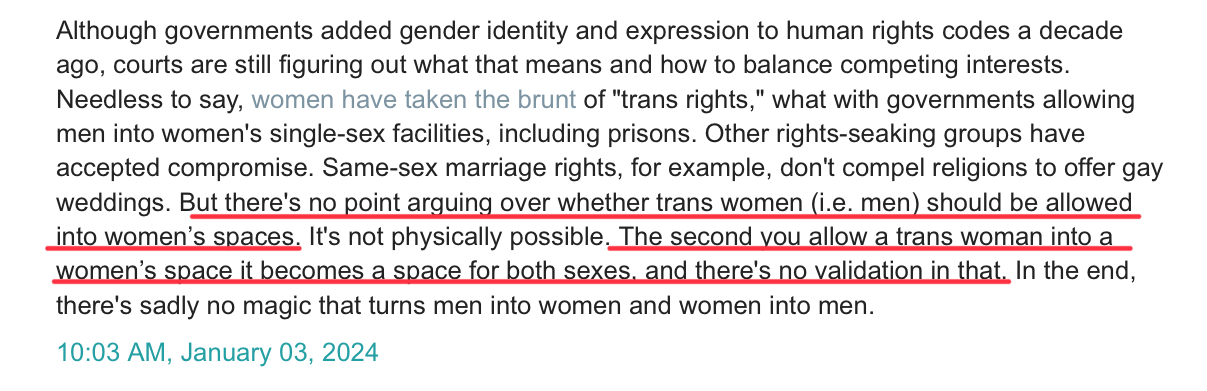

Most of what this talks about, I’ve already addressed earlier.  However, it is revealing of several assumptions which need to be examined more specifically.  

First is the idea of “sex-based” here.  I’ve already discussed how “man” and “woman” are as much social roles as they are rooted in the physical body. The bugaboo here seems to be the mere idea that someone in the “ladies” might possibly possess a penis.  When we are talking about washroom facilities, the room marked “ladies” is all but universally individual stalls.  So, it’s difficult to understand how a transgender woman using a stall is any more of a threat than any other woman, regardless of whether they have undergone genital surgery or not. Someone trying to peer over, or under a stall is engaging in inappropriate conduct regardless of their genitalia.  As I previously noted about the issue of sexual assaults, we have to recognize that those happen, but to engage in collective punishment / restriction of a population because of the actions of one or two individuals is simply repugnant.  

The second part of your claims rests upon the general idea that “some sexual predators will claim to be transgender to gain access to prey”.  I’m not going to argue that there are no sexual predators in the transgender community - such a claim is trivially refuted.  However, such overlaps are rare and it’s going to be even more rare for an actual predator to “dress up as the prey”.  The reason for this is fairly simple: most sexual predators are engaging a power and violence motivated behaviour, and it is highly unlikely that they will “dress up as their prey” because that would be symbolically emasculating themselves.

Further, I would like to point out to you that women in general are not above committing sexual assault either. The research on this is still fairly sparse, but consider the following exploration of the subject in women’s prison facilities.


The long and short of my point here is that even those who are assigned female at birth (AFAB), and are raised in the appropriate gender role are not above being sexual predators either. I would argue that someone who is transgender, and has been socialized in their chosen gender role is unlikely to be any more of a danger.  

Someone possessing a penis, or having possessed a penis in the past, does not make them intrinsically a threat.  If that was the case, we would have locked men away from women entirely decades ago.  But it’s similarly inappropriate to say that a transgender woman is a “man” because socially and emotionally, they ARE NOT (and your own argument earlier seems to recognize this).  Further, such suppositions make no sense when we are talking about those who have undergone surgeries, yet these broad stereotyping approaches attack all transgender people regardless of their individual realities. 

I would go so far as to suggest that you have likely interacted with transgender women in a wide range of contexts, including “sexed spaces”, and not even realized it, much less having had some catastrophic event occur as a result. Using individual events without evidence of there being a wider problem in the transgender community is disingenuous and suggests that you are falling into believing stereotypes that have no more validity than those which were used to justify segregation in the US, and Apartheid in South Africa. 


Monday, January 01, 2024

When An Argument Starts From A False Premise ...

This essay came up on my Twitter feed this morning.  Titled "In Defence of Gender", it's a lengthy piece of writing which attempts to justify taking a "both sides" approach to the current uproar over transgender rights - or perhaps I should say, inclusion of transgender women in society - because that's what a lot of it boils down to.  The essay was apparently published in March, 2023 - I was unable to address it at the time because I was caught up in issues related to the current efforts to push transgender women out of society (that's another story, for another day) - I will write my piece on it eventually. 


My objection to the opening paragraph should be clear enough to long time readers.  It's not a zero-sum argument when one side is accusing transgender women of being a myriad of things that cast them in the light of being an immediate danger to others.  When one side of an argument is literally engaging in eliminationist rhetoric, that isn't a "both sides" moment.  That's a "whoa - on what basis do you make that claim" moment.  We've seen this script before, and it's fucking messy. 


There's two things here I want to address.  First is this bizarre idea that "anybody who is uncomfortable with their body must be trans".  This isn't a thing. No mental health professional would ever do that, much less make a diagnosis that the person is transgender based on it.  This is one of many problems with what the author calls "Gender Critical political analysis" - it starts from false premises which have no basis in reality.  In fact, the entire construct of what Gender Critical (GC) writers call "Gender Ideology" is basically a form of straw man where they have created it, and dumped all of their anxieties about transgender people into it. 

Second is the idea that "biological sex is real, gender is a fiction".  Again, this comes largely out of the GC conceptualization of "Gender Ideology".  Early TERF writers often would rely on a very incorrect interpret of Judith Butler's early 1990's book "Gender Trouble" (among other feminist theorists).  They misinterpreted Butler's analysis, and they continue to do so now.  Butler's view is more correctly understood as there are social and psychological dimensions to gender roles that are external to the "gendered body" of the individual.  Part of the confusion is that the terms "gender" and "sex" are often used as synonyms for each other, and the reality is quite different.

Butler was talking about the social constructs that are built around a person's sex - the ideas of what it means to be a "man" or a "woman".  Womanhood in particular in Western cultures is built up around a combination of physical attributes as well as social expectations associated with, for example, the ability to produce children.  However, the idea that "gender is performative" created a somewhat problematic division that people still struggle with.  What aspects of "womanhood" are "intrinsic" to a female body, and what aspects are social constructs?  For example, not all women who bear children turn out to be willing or good mothers.  

Butler's model provokes us to ask what are the valid limits on what men or women should behave like in social contexts.  It does not make the claim that "gender is a fiction", nor do transgender people.  Transgender people do provoke a lot of very uncomfortable questions about exactly what those boundaries really look like.  

Here we come to the point where the writer starts commingling issues to arrive at a "thorny problem".  She asserts "When vulnerable women's safety is at stake ..., we cannot simply take everyone at their word when they assert that they too belong in those spaces".  Are transgender women not subject to sexual assault? Further, this also assumes that women do not engage in sexual assault.  She then goes on to argue (in essence) that because there is no clear "gatekeeping" on who is a valid transgender person, it is too easy for male predators to "cosplay being trans" to gain access to victims.  

There's a fundamental problem for this argument.  Sexual predators generally do not "cosplay their victims to gain access" - that would be symbolically emasculating themselves.  Sexual predators are engaging in a power and violence game, and cosplay would be humiliating to them.  (I'm generalizing here - I know there are exceptions).  

The problem here is one of generalization.  To assert that because "some" transgender persons are sexual predators, that all transgender women must be excluded from "vulnerable spaces" is effectively engaging in a form of class punishment.  It is also offensively reductionist, ultimately turning into an argument that it is the penis (or imagined penis) that makes a person a threat.

Further, in spite of transgender people being significantly more visible in the last 15 years, the fact is that transgender women have been using "vulnerable female spaces" for many decades without any actual problems - a fact that many anti-transgender activists completely ignore. 

The writer goes on to opine on the treatment options for transgender people - and transgender youth in particular.  

I will simply point out here that based on her bio alone, Dr. Italia is completely unqualified to provide any such commentary.  Maybe leave that subject to people who have actual expertise, because your arguments here are basically "yes, let's traumatize more transgender people by making them suffer through a puberty that might just render them suicidal".  


Ah yes, deadnaming.  Here's the thing, if I tell you my name, I expect you to use it.  I don't expect you to go digging up something from my past and then use that to invalidate what I am writing today.  That's the critical piece here.  Changing one's name doesn't erase personal history, nor does it change who a person is today.  It's a name, not a definition.  

Let's be clear about how the GC world uses deadnaming.  It's a weapon.  They use it to silence and invalidate the voices of trans people.  It isn't used in "good faith" (in fact, it can't be).  You want to know why it gets blowback?  Because it's disingenuous and always used to prop up an otherwise unsustainable argument.  

Even here, where the author seemingly starts to moderate her stance a bit, she has to attempt to dismiss neuroscience.  Neuroscience is hardly "embryonic" these days, and arguably hasn't been in that state for a good 20 years or more.  There is a sizeable body of research showing the results she so easily dismisses.  

Speaking of ignoring science, here we go again.  Her interpretation here is hugely problematic because it essentially makes an effort to dismiss the existence of intersex people in the understanding of bodily sex.  This is hugely problematic, especially in light of the neuroscience evidence she referred to (and ignored) earlier. 

A more correct understanding of bodily sex is to think of it as a bimodal distribution, one with major peaks at the male and female ends of the spectrum, and a small number of people in between for a variety of reasons. Further, understanding that within the concept of gender identity there are also those who experience themselves as neither "man" nor "woman" per se, but rather fall somewhere in between, lends more credibility to the findings in the neuroscience domain as well.  


And here again, we have the author demonstrating how little she grasps of the scientific research around gender identity.  There's a compelling reason that Blanchard's model has not been adopted - it fails entirely to explain anything more than a tiny sliver of the transgender community.  Lengthy criticisms of the "autogynephilia hypothesis" have been published elsewhere - all I am going to say is that none of the papers I have seen supporting autogynephilia are particularly persuasive either in their arguments or in the data provided.  At this point, I view it as basically junk science that deserves to be in the same bin as Rapid Onset Gender Dysphoria.

The GC world is engaging in an attempt at erasure - elimination, if you prefer.  They have fabricated a mythology of what it means to be transgender, and then they have turned the community into a collection of what they perceive to be monsters and extremists.  You cannot "both sides" this argument, not when one side is literally attacking a minority population with falsehoods, misinformation and bogus "theories".  There is no "debate" here - the GC world has argued for restrictions based on imagined hazards, rather than showing that there is an actual threat. 

Fundamentally, the argument for accepting transgender people as members of society is simple:  Transgender people exist, and they have existed far longer than most of today's wave of anti-transgender politicking has.  There is simply no compelling reason that your fears about transgender people are a valid justification for exclusion. Work through your own damn insecurities, because the trans community has already done their own work on that front. 


Sunday, August 15, 2021

Untangling Sex

The discourse around transgender people often breaks into two sides screaming at each other, one arguing that 'gender is a social construct', and the other stamping their feet and yelling that such an argument denies the biological realities of women.  Both positions are correct from certain perspectives, but the "biological" argument fails to recognize the deconstruction of "sex" that many transgender people find themselves forced to engage in, and that deconstruction forms the basis for a much more nuanced discussion of both the social and physical issues involved. 

In this essay, I will endeavour to walk the reader through the concepts involved in the deconstruction of sex that transgender people often use as they are coming to an understanding of their own experience which is so different from that of their peers.  I will then start to explore how this deconstruction opens doors to much more complete discussions of the issues faced not just by transgender people, but by all of us as we navigate our way through society. 

Tuesday, July 29, 2014

Radical Feminism Versus Reality

The New Yorker decided to publish an exposé about the ongoing war of words between Transsexual Exclusionary Radical Feminists (TERFs) and transsexuals.

Sadly, the author spent most of their time talking about what TERFs have written about transsexuals and failed entirely to present the transsexual side of the discussion in any depth.  In fact, the entire article came across as if the transsexual community's reactions to various TERF proclamations about transsexuals were simply an overreaction.

While I have no doubt that there are those whose fury over the acts of various TERFs towards the transsexual community is such that they have made threats or been otherwise unpleasant about things.  The transsexual community is hardly uniform in its sensibility or willingness to discuss topics when they feel they have been slighted.
Such views are shared by few feminists now, but they still have a foothold among some self-described radical feminists, who have found themselves in an acrimonious battle with trans people and their allies. Trans women say that they are women because they feel female—that, as some put it, they have women’s brains in men’s bodies. Radical feminists reject the notion of a “female brain.” They believe that if women think and act differently from men it’s because society forces them to, requiring them to be sexually attractive, nurturing, and deferential. In the words of Lierre Keith, a speaker at Radfems Respond, femininity is “ritualized submission.”
One might wonder just what room for dialogue there might be when the TERF argument starts with absolute erasure of the lived experience of transsexuals.   Perhaps even more troubling is that the TERF position clearly ignores a large and growing body of evidence that does show that masculinized and feminized brains are objectively different (and that transsexuals reflect brain structures that tend towards female typical).

In many respects, it isn't the TERF's denial of the reality of transsexuals that gets people wound up.  I think if it were merely a disagreement over philosophical points of worldviews, it would be far less contentious than it is.

Unfortunately, TERF writers going back to Janice Raymond, author of a treatise entitled "The Transsexual Empire" have done their level best to erase the narrative of transsexuals.  Quite frankly, Jeffrey's latest work is really just another volley in an ongoing war where transsexuals are concerned. There is very little in it which is new, revolutionary or even evolutionary.

Whether or not "Radical Feminist" theory has any legitimate criticism of the social roles assigned to our male and female citizens is unfortunately lost in the core assumption that denies transsexuals the right to their own stories.  Jeffreys, along with the other TERF writers are blinding themselves to the growing evidence of biology and how it influences the expression of gender.  The rigidity of the TERF position is also its brittleness.  Feminism needs a new direction to evolve.  The work started so many years in the past has not been finished yet, and yet it cannot move forward without including the diversity of gender identities and roles that have emerged in the last 25 years.  I firmly believe that the TERFs like others with rigid, inflexible belief systems will become the intellectual dinosaurs in the coming years.


The Upcoming SCC Ruling in English Montreal School Board v. Québec

On Friday, November 20, 2026 the Supreme Court of Canada (SCC) announced that it would release its ruling on Québec's infamous Bill 21. ...