Sunday, January 30, 2022

About That Convoy ... Protest ... Whatever

As we speak a bunch of anti-mask/vaxx/generally pissed off with govt types are clogging things up in Ottawa. 

Frankly, this is a bunch of loudmouth idiots who have fallen down the rabbit hole of QAnon / MAGA conspiracy thinking egged on by a bunch of grifters who have managed to hoover up a considerable amount of money. 

What these people "think" is going on with the pandemic is so far removed from any reality that it renders their ideas irrelevant. They seem to think that governments can "just wave the pandemic away". Of course, no virus pays attention to the politics of the day - and the money behind this protest know that too. 

At the end of the day, this is a test run of the next iteration of the "Ragey Right" that started with the emergence of the Tea Party in the US. I see these people as little different than Hitler's so-called "brownshirts" in the 1930s. Loud, violent, and basically willing to stoop towards violence in order to intimidate the rest of the country into quiet compliance with them.  

The Tea Party fizzled out in the US - becoming a rump faction within the GOP (although like the SoCons in the CPC, it's an influential rump). The most recent incarnation in the US is the MAGA thing, which ultimately culminated in the Jan 6, 2021 insurrection. The two "convoy protests" in Canada have been more oriented around perfecting the money side of the picture.  

This isn't going away, but make no mistake about how it is being driven by the same apparatus that drives Rebel Media, CPC fundraising, and so on. It's all about getting people upset enough that they will donate money to it, regardless of whether that money actually goes to the "outrage issue of the day" or not. 

Friday, January 21, 2022

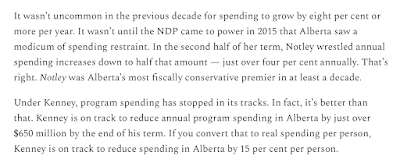
Kenney Is On The Right Track?

So, according to Ken Boessenkool,  we should congratulate Jason Kenney for "being on the right track".

I get it - Ken's a conservative organizer, and he's going to think that Klein's tenure was some kind of high point.  It wasn't, and I think we all know that - we've spent that 15 odd years since Klein stepped down cleaning up the mess that he made.  There's a whole lot more to good government than just "balancing" the fiscal books.  

So, what does he think Kenney is winning on? 


Ah yes ... the old conservative saw about "cutting spending". In Alberta politics especially, this is held as some kind truism.  The government is always "wasting money", or "we're spending too much".  

The logic usually goes something along the lines of "OMG, govt spending is increasing at a rate greater than inflation!" (or inflation plus population growth ... or whatever other axis you want to use). Therefore, the automatic assumption is that we are spending too much. The problem with this logic exists in multiple axis of consideration that our conservative friends almost never seem to address in their arguments. 

For example, the most basic of business case analyses - cost / benefit - is almost never present. In pure business terms of course, cost/benefit analysis is purely a matter of $.  If I spend $X on a project, and it comes back with $Y in revenue, is Y > X.  (Yes - I'm simplifying here).  We don't even get that far with government spending analysis done by conservatives. 

When we talk about analyzing government programs, it's even more complex.  The costs and benefits of any program may well not be easily measured. For example, lets look at what is commonly called welfare.  It looks like a straight up cost sink. The government puts $X into the program, and gets nothing back out, right?  Wrong. That $X put into the program has impacts all over the place. It reduces homelessness, it reduces petty crime (B&E, shoplifting, etc) because recipients are no longer desperate for the basic resources to survive, it reduces healthcare costs because mysteriously, people actually have the money needed to eat, so they aren't showing up at emergency with conditions exacerbated by malnutrition, etc. 

The benefits of government spending are hard to quantify sometimes.  That doesn't mean we shouldn't do so.  

The value of a funded and functional healthcare system vastly outweighs the costs - even when it is a large proportion of the government's spending. People who aren't worried about whether they can afford to get sick or not are more willing to take economic chances - like starting a new business.  Businesses benefit because suddenly they don't have to provide hugely expensive healthcare insurance plans for their staff (call that one an undeclared payroll tax). Large scale investment also looks at whether people are willing to move to a place - and healthcare is near the top of most people's agendas - for good reason. Likewise, a funded and functional education system is hugely important, and should not be used as a political football as Kenney has done in Alberta. The benefits vastly outweigh the costs, but those benefits are 20 years down the road. 

Needless to say, I have never seen a conservative talk about these benefits in any kind of reasonable way, or what we may be giving up by focusing on "balanced budgets".  

The other side of that same coin is the revenue picture. Alberta's revenue picture has been abysmal since before Klein. Our governments have insisted that a PST or HST is absolutely off the table, and there are frequent bragging sessions about having the lowest tax rates in the country. They paper the fiscal holes with one-time royalty dollars that should be flowing into the Heritage Savings Trust Fund.  (Getty quit putting money in there in the 80s).  Again, it's cheap populist politics in Alberta to say that raising taxes is unnecessary - just tighten the belt a bit further. Conservative politicians seem utterly oblivious to the fact that the revenue side of the picture also needs to be considered, and it is not reasonable to hold the line at unrealistically low tax rates. 

So, will Mr. Kenney's polling fortunes improve on a wave of "good economic news"?  Probably.  But nobody should be fooled into thinking that he is in any way capable of, or willing to, understand the value of government spending.  

Sunday, December 12, 2021

Bill C4 - Conversion Therapy Passed - Now What?

To my surprise, Bill C4 made it through parliament in record time.  Personally, I think this is a good thing.  However, I also know that Social Conservatives and Gender Critical factions will ally with each other to challenge the legislation in the courts.  

I suspect there was an agreement drawn up in the CPC caucus to allow the bill through with a minimal amount of fuss because they have finally figured out that pushing attitudes that go back to the 1950s probably isn't going over well with Canadian voters.  In a minority parliament, the last thing a party that has lost 3 elections in succession wants is to be tainted again with various members engaging in bozo eruption moments over a hobby horse issue.  

However, let's put political strategy aside and take a look at the likely avenues of attack that will be used in the courts to argue that Bill C-4 is either too broad, or overly intrusive into the lives of Canadians.  

Tuesday, November 30, 2021

Conversion Therapy and Affirmative Therapy

Now that the LPC government has tabled Bill C-4, it's probably a good time to examine the two terms that are inevitably going to be argued about the most with this legislation.  Specifically, I want to talk about the terms "Conversion Therapy" and "Affirmative Therapy".  

I will be doing this primarily through the lens of mental health therapy, although in the coming debate over Bill C-4, you can expect that to get conflated with medical interventions such as surgeries or hormone therapies.  The relationship between mental health and medical interventions is a separate matter that will be addressed in another article. 

Wednesday, November 17, 2021

There Is No Such Thing As A "True Conservative"

In his column for yesterday's National Post, John Robson opines that the problems that Jason Kenney and Erin O'Toole are having with the electorate are because they aren't being "Real Conservatives" (or "Conservative Enough").  

No, Mr. Robson, that isn't it at all. Perhaps it's escaped your notice in the last couple of decades, but conservatism has changed, and the evidence of that change exists in many places. The selection of leaders like Kenney, Scheer, and O'Toole are evidence of that change. The change started decades ago, and it solidified when Harper engineered his take-over of the PCs and Canadian Alliance parties to form the current CPC.

Yet, every time a conservative runs headlong into the reality that they aren't winning, writers like Mr. Robson start opining that it's really because the politician isn't "a true conservative".  I don't know what this "true conservative" looks like, and frankly I suspect that such an animal doesn't really exist. 

Why do I say this? Because the claim itself rests upon a 'No True Scotsman' fallacy. Writers who make this claim are blinding themselves to the reality that is unfolding around them. Today's Conservatism is no longer some semi-idealized version of a politics that was opined into existence in the 19th century. It has changed.

Conservatives chose to rally around Harper, Kenney, Ford, and more recently O'Toole ... and frankly voters are turning their backs on this brand of populist, deceitful conservatism for good reason.  

Kenney has been sliding in the polls for at least the last year. Why? Because once in power he showed us who he really is with arrogance, condescension, and lies. He has earned the ire of voters in Alberta for a bunch of reasons - but he is very much the face of today's populist conservatism. 

O'Toole came out swinging in the election, and in some ways did far better than expected.  But - and it's a big but - he lost ground in the key province of Ontario. Since losing to Trudeau in 2015, the CPC has all but undone the gains made in Ontario that helped the party win in 2006. What was it that caused them to lose in 2015? Harper dropping the veil and showing us the ugly side of the CPC - whether that was an elitist view of citizenship, or the overt racism of the campaign (Old Stock Canadians, Barbaric Cultural Practices Hotline, etc.).  

You see, these, are the values that conservatism has come to hold in Canada. Language like "Traditional Social Values" no longer means what guys like Robson seem to think it does.  It has become code-speak for a miserable combination of elitism and bigotry drawn from the worst elements of the 19th century British Empire. Fiscal probity, something conservatives have long claimed to be the natural proponents of, has become coded language for letting the wealthy off from paying their fair share towards the nation, and throws in a side helping of corporate greed.  

Conservatism today isn't what Robson thinks it is, and the fix isn't for "Kenney and O'Toole to act more like conservatives" - they are what conservatism has become. 

Figure out what conservatism should be, and find a way to that place. Don't insult Canadians' intelligence by telling us that the worst leaders of the movement "just need to act better".  The movement needs to change. 

Tuesday, November 16, 2021

Prognostications On The War In The UCP

 The UCP in Alberta is at war with itself, and the war has broken into the open just before their Annual General Meeting (AGM).  

What’s the fight over? No less than Jason Kenney himself. 

Make no mistake about it, the UCP was formed to be a vehicle for Kenney to ride to power and control the province with. For that party to now be looking seriously at kicking Kenney to the curb is somewhat astonishing, but here we are. As of yesterday, some 22 Riding Associations (RA) had signed on to a letter demanding a leadership review ASAP, and more are expected to follow suit, a number which meets the threshold in the Party Constitution to force the matter.  

What are Kenney’s options? 

I see a handful of scenarios for Kenney: 

Scenario 1:  He Tries To Hang On

Kenney sees himself as an invincible campaigner.  It’s possible that he thinks he holds enough cards that he can persuade the bulk of the active party membership to endorse his leadership.  This would, in some ways, be the best possible path for Kenney’s public image - if he can survive a leadership review at this time, he comes out looking like a much more dangerous foe to his opponents both within the party and outside of it.   

Scenario 2:  The Leadership Review Happens, Kenney Is Booted

More likely, given what we’ve seen so far, is that enough of the party is either pissed off about “COVID Restrictions” (rural ridings), or are panicking about the upcoming 2023 election (urban ridings), that Kenney comes to be seen as a liability.  

 With Brian Jean once again stalking around the leadership discussion, one might imagine that this is a far more likely outcome for a governing party whose polling numbers are at all-time lows, and whose leader is increasingly seen as a small, petulant man unwilling to do the right things by anyone except his own interests. 

Scenario 3:  An Agreement With Party Brass

Kenney might make an agreement with party brass to hang on until just before the planned spring leadership review. If he doesn’t think he can win that with a sufficient fraction of the party support, then he “goes for a walk in the snow” and announces his retirement from Alberta politics. 

Given Kenney’s ego, this scenario seems unlikely, but it might occur if Party Brass initiates it and manages to convince Kenney to do something that will allow the party to continue on afterwards. 

Scenario 4:  Nuclear Option

Kenney’s last option is basically “nuclear”.  He walks to the Lieutenant Governor’s residence, and asks for the dissolution of the legislature, triggering an immediate election. 

He has already threatened to do this to keep an increasingly unruly caucus in line, and doing it right now would likely blow the party apart. He knows he would lose the election, but this would be an act of political revenge on those who dared oppose him. Remember, this party was built around Kenney in the first place, and I suspect he sees it very much as “his party”.  That makes it quite likely that he’ll be willing to play the “if I can’t have it, nobody can” card.  

The consequences would be grim for the party, because Kenney would likely as not refuse to sign the nomination papers for anyone who has dared challenge him, forcing them to run as independents or not run at all. 

It would put the party itself in a “come from behind” situation, and one that given current polling would practically hand the election to the NDP.  

Either way, the next few days will be very interesting, as Kenney will be fighting for his political life, and frankly may well see it as “I’ve got nothing to lose”. 

Outcomes

The first 3 scenarios don’t trigger anything immediate for Albertans.  At most we get a sideshow spectacle as the UCP attempts to hold itself together during a leadership race.  Now, I don’t think the UCP is truly “united” - mostly because it is made up of the same constituencies as the Federal CPC, and unlike Harper, Kenney lacks the leadership skills and character needed to “bring them together” and foster cooperation.  Part of that arises from being so clearly a member of the SoCon faction - anything he does there is subject to accusations within the party that he’s favouring that faction over others. That means a snap leadership race is probably going to inflame divisions, not heal them.  

The last scenario is by far the “bloodiest” politically.  It will blow the conservative movement in Alberta apart and set it back for at least a decade electorally.  The UCP is unlikely to survive a snap election call.  Even if Kenney believes he can win the vote, the party won’t survive. Voters would rightly look at this as a cynical political maneuver by Kenney, and likely as not would punish him at the ballot box.  New candidates that are unknowns because he refused to sign nomination papers for incumbents won’t be easily elected, no matter how “amazing” a campaign Kenney executes - especially in urban Alberta, where the level of disaffection has clearly hit party support the hardest. 

The UCP would likely fracture into 3 major subgroups:  urban conservatives (mostly fiscal hawks, I suspect), rural conservatives (predominantly libertarian), and social conservatives. If Kenney thinks that he’s got a problem “herding cats” now, it’s nothing on what will happen when those 3 groups start squabbling over control of the UCP corpse.  

What Happens To Kenney? 

Quite frankly, I think Kenney’s days as an elected politician are over.  He won’t return to elected politics for at least 2 full election cycles - his brand is tarnished by a series of avoidable, unnecessary mistakes - ranging from simply being petulant and petty with the Federal government to being seen as unlikeable and arrogant.  He might be a “tireless campaigner”, but his ability to portray himself as “oh so reasonable” has been badly damaged in voters’ minds both provincially and federally. 

Expect to see a defeated Jason Kenney join Harper and Associates, becoming an “advisor” to whoever replaces Erin O’Toole in Ottawa.  

Thursday, November 11, 2021

A Few Thoughts On The Rittenhouse Trial

 The Kyle Rittenhouse trial is a farce.  A travesty, and potentially will end up being one of the most egregious miscarriages of justice in history (and not just US history, either).  

From the get-go, it’s clear that the judge has an agenda:  to get Rittenhouse acquitted.  That shows up time and again, whether it is a ruling on the language that can be used in the courtroom to describe the people that Rittenhouse shot, or clearly trying to hamstring the prosecutor’s line of questioning, the judge is playing games because he knows this trial is being watched closely by other Trumpists.  My guess is that this judge is playing electoral politics - but he’s also playing with fire - and the fire is outside his courtroom. 

I’ve mused repeatedly on this blog about how toxic partisanship has become in our politics. Remember that in the US, county level judges are elected, and therefore are intrinsically political to begin with. Schroeder’s actions during the Rittenhouse trial strongly suggest bias in the case, and call into question how objectively he can oversee the trial. 

My expectation at this point is that Rittenhouse will be acquitted - even though there is plenty of evidence to demonstrate not just intent, but a violent intent tinged with an unpleasant side of racism. But, when the judge overseeing the trial does things like rule that you cannot call the victims of a shooting ‘victims’, it’s pretty clear that the trial is already prejudiced. 

… and then there’s the point in the trial where the judge’s cell phone starts ringing, and it happens to play the song that Trump uses when he walks on stage.  That’s where partisanship walks into the room and drops its pants. 

The results of this trial will go down in history as the moment that it became abundantly clear that the American judiciary has become a purely partisan entity, and it will then come to matter in the courts whether the accused is known to belong to “the other party”, or if the accused is being tried for something that the judge’s party approves of.  

Even if an acquittal is eventually overturned on appeal because of various legal errors made by the presiding judge, the fact of the matter will still be that the trial process - especially at the local levels - is now subject to partisan considerations.  If you thought the riots after George Floyd was killed were something, just wait until marginalized people figure that out.  

The Upcoming SCC Ruling in English Montreal School Board v. Québec

On Friday, November 20, 2026 the Supreme Court of Canada (SCC) announced that it would release its ruling on Québec's infamous Bill 21. ...